 Back
Back
With Giving Tuesday and the holidays just around the corner, now is the time for your nonprofit to expand its reach, solidify relationships with supporters, and prioritize fundraising to finish the year off strong. In fact, it’s estimated that 38% of annual giving takes place in December and November, with 12% donated in the last week of the year.
To make the most of this giving spirit, your nonprofit must plan an engaging year-end giving campaign. You’ll need a marketing, communication, and fundraising strategy guaranteed to stir up excitement and maximize support for your cause. While this might seem overwhelming, the right software can streamline the entire process.
To help your nonprofit increase its end-of-year giving, this guide will cover:
The clock is ticking, so crafting your fundraising strategy today will put your nonprofit in the best position to hit your annual goals. Let’s begin!

Year-End Giving FAQs
What is a year-end giving campaign?
A year-end giving campaign is a focused effort to maximize fundraising around the holiday season. While many nonprofits launch their year-end giving campaigns before GivingTuesday—the first Tuesday after Thanksgiving—some start as early as October. Starting sooner than later is always preferred; however, your nonprofit can still run a successful campaign if you start in mid-November, at the latest.
Remember, preparing a year-end giving campaign isn’t a one-person job for your fundraising chair! You’ll need all hands on deck, including support from board members, volunteers, and donors, to help your nonprofit reach the end-of-year finish line.
What are the different types of year-end giving campaigns?
Nonprofits launch a range of year-end giving fundraisers, meaning there’s no one-size-fits-all answer. However, some of our favorite fundraising strategies include:
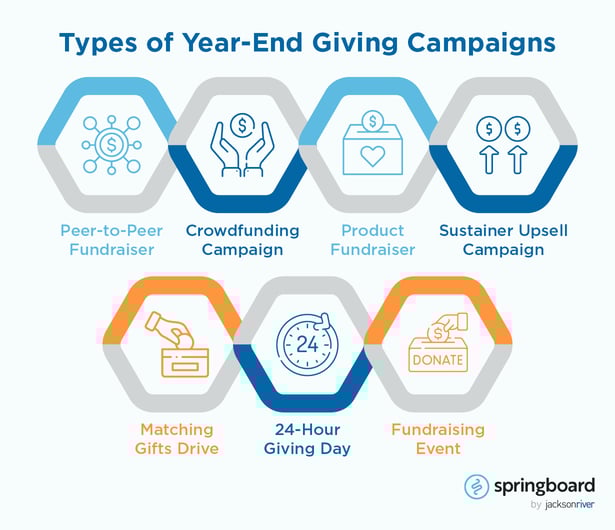
- Peer-to-peer fundraiser. Peer-to-peer fundraising empowers your supporters to take the reins on fundraising. Through your organization’s peer-to-peer software, supporters can create their own fundraising campaign pages and share them with their networks. Peer-to-peer fundraising is highly flexible, meaning it can work as a standalone online fundraising campaign or be paired with an event.
- Crowdfunding campaign. Crowdfunding also relies on social sharing to succeed, but supporters give to one centralized campaign rather than individual donation pages. Set a goal and deadline for your fundraiser to create a sense of urgency, and keep supporters updated on your progress via a fundraising thermometer. If you go this route, you’ll likely receive many small donations that add up.
- Product fundraiser. With a product fundraiser, your supporters purchase items and your nonprofit earns the proceeds—it’s a win-win! Many nonprofits launch product fundraisers with a holiday theme by selling treats like cookie dough or candy, wrapping paper, and decorations. Leverage your supporter base to help sell the products, and arrange for a smooth delivery process so donors can enjoy their items by the holidays.
- Sustainer upsell campaign. Tap into your existing donor base to encourage recurring donors (or sustainers) to upgrade their gift before the end of the year. Ask one-time donors who you think would be receptive to increasing their involvement to join your sustainer program as well. Develop segmented emails for your recurring donors to send them year-end donation appeals, which can create a donation pipeline that carries over to the next year.
- Matching gifts drive. While your organization can benefit from employer matching gifts year-round, the end of the year is a great time to get started if you don’t already take advantage of this CSR program. The best way to do this is to invest in a corporate giving database to identify eligible supporters. Then, embed this tool into your donation page so supporters can easily discover if they qualify for any programs.
- 24-hour giving day. Take advantage of popular donation days, like GivingTuesday, with a 24-hour online campaign where supporters can “unlock” perks by reaching various fundraising goals.
- Fundraising event. In addition to raising funds, events bring your community together to support your nonprofit’s mission. Host fundraisers in-person or online and choose activities that resonate with your audience, from galas to auctions to fun runs to family movie nights. If you aren’t sure what event will appeal to your supporter base, survey them to gauge their interests.
The best year-end fundraisers for your nonprofit will depend on your budget and audience. But no matter what idea (or combination of ideas) you try, ensure your campaign is designed to create urgency and increase supporter passion for your mission.
Why is year-end giving valuable?
Along with providing a significant portion of your annual fundraising revenue, your year-end campaign can also open your nonprofit up to new audiences. Year-end giving is the perfect opportunity to reach new supporters with an interest in your cause and convince them that you’re the right nonprofit to support. Then, you can work towards building relationships and retaining their support during the new year.

Year-End Giving Strategies
Before you can jumpstart your year-end giving campaign, you need a plan of action. To earn as much support as possible, create a roadmap for how you’ll execute your campaign. Get started by exploring these essential end-of-year fundraising strategies.
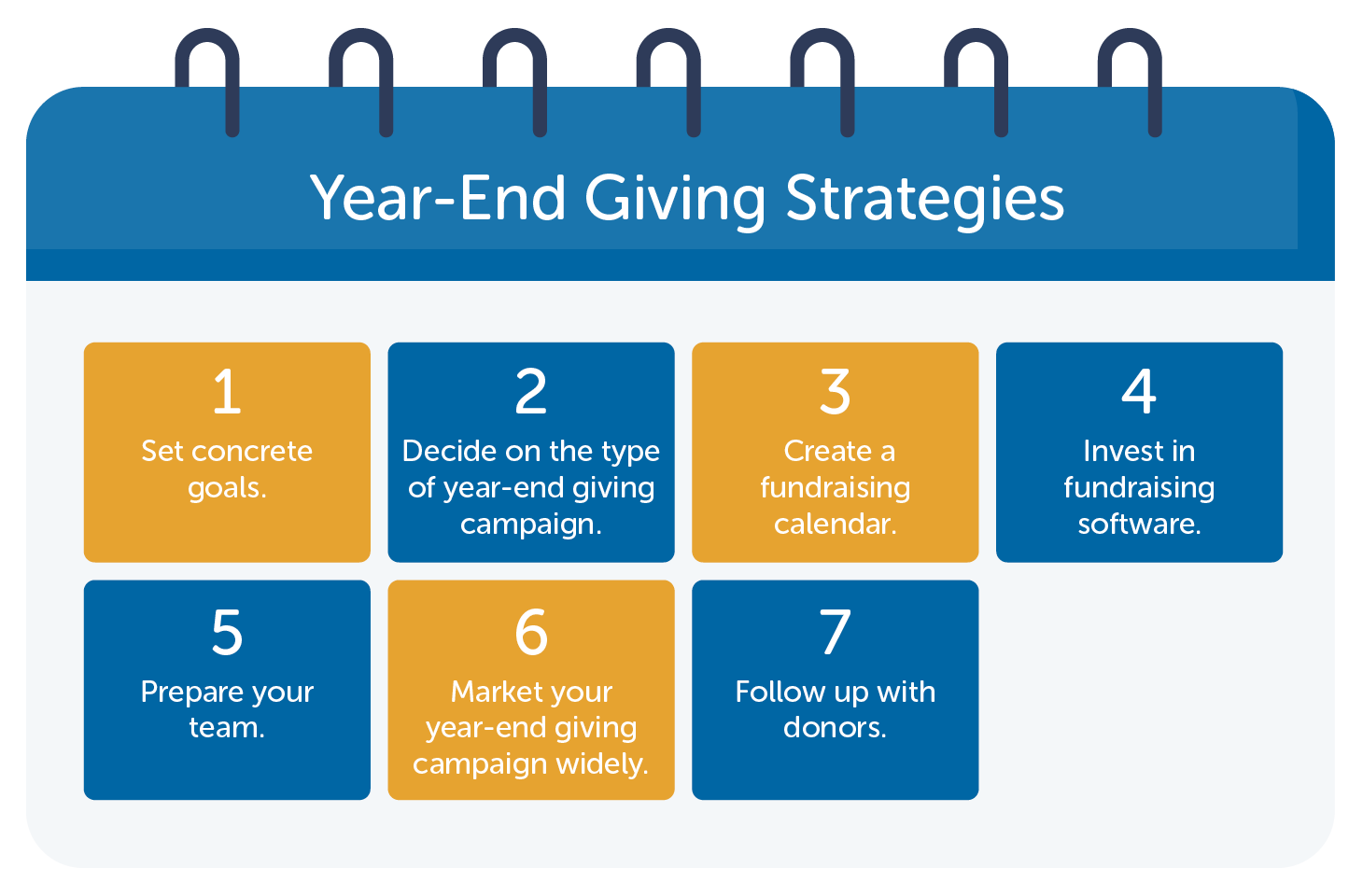
1. Set concrete goals.
Your nonprofit needs to set ambitious, yet reasonable goals that you’ll work towards achieving. If you ran a year-end giving campaign in the past, reflect on how much money you raised, how many donors you reached, your donor conversion rate from your communications, and more. This information will provide invaluable insight into how you can reshape your strategies for this year and the new goals you should set.
You’ll also need to decide on logistical details, such as the timeline for your campaign and when you hope to achieve certain objectives. Planning your campaign as early as possible is key to maximizing support for your organization. After all, how can donors give to your campaign if they don’t have enough notice? Your organization will need to develop strong communication and marketing strategies that keep donors informed, engaged, and eager to give.
Meet with your nonprofit’s board and volunteers to gather different ideas and delegate responsibilities. End-of-year fundraising is a huge project that requires a significant time commitment, so ensure that everyone on your team is willing and able to contribute.
2. Decide on the type of year-end giving campaign.
There are many different fundraising styles your nonprofit can incorporate into its year-end campaign. Since year-end giving is highly flexible, you can even combine different fundraising types together so you can appeal to different donors’ interests.
If your organization chooses to host a fundraising event, you’ll need an engaging idea. A holiday-themed idea can stir up passion for your cause and motivate people to give. For example, your nonprofit could consider hosting any of the following:
- Themed walk-a-thon. Add a twist to this classic fundraising event by inviting your supporters to wear ugly holiday sweaters, dress up as their favorite holiday movie character, or other fun challenges tied to the holiday season.
- Holiday concert. Ask a local band or musically talented volunteers to perform classic holiday songs in person or through a live stream.
- Decoration workshop. People love decorating their homes during the holidays, so invite them to a workshop dedicated to creating custom ornaments, lawn decorations, or other fun items to celebrate the end of the year.
Your nonprofit can charge a registration fee and even run an online fundraising campaign in conjunction with your event to open up another revenue stream. This way, people who can’t attend your event can still support your nonprofit’s cause by donating.
3. Create a fundraising calendar
The year-end giving season is a busy time, and it’s easy to mix up deadlines and let projects slip through the cracks. Prevent this by creating a dedicated fundraising calendar that tracks all of your ongoing projects.
Many nonprofits maintain multiple fundraising calendars. Their annual fundraising calendar provides a high-level overview of projects for the entire year. Then, to nail down individual tasks and deadlines, you would create month-to-month calendars.
For example, your annual fundraising calendar might simply mention that you are running a peer-to-peer campaign in December. Then, your calendar for December would mark the date you’re onboarding peer-to-peer volunteers, when your regular check-ins are, and when your event to celebrate the campaign’s end is.
You can also create a dedicated year-end fundraising calendar for a more granular view of your activities from October through December.
4. Invest in fundraising software.
Year-end giving campaigns have a lot of moving parts and can easily get overwhelming. To streamline the planning and execution process, your nonprofit needs to work with a comprehensive fundraising software you can trust.
Springboard by Jackson River is the best fundraising platform to meet your nonprofit’s unique needs. With its digital-first approach, Springboard has a robust set of tools to create an authentic donor experience and assist your organization with its entire fundraising campaign, from start to finish.
Springboard’s intuitive features include the following:
- Customizable website builder. Easily create fundraising websites carefully tailored to your audience’s interests. If you’re hosting a peer-to-peer fundraiser, volunteers can easily create their own unique pages that they’re proud to share with their personal networks. Plus, Springboard makes it simple to add your unique branding elements (including font, color scheme, and images) so your site accurately represents your nonprofit.
- Social media integrations. The key to running an end-of-year giving campaign is marketing your campaign to as many people as possible. With Springboard’s social media integrations, you can easily share your mobile-optimized donation page across popular platforms like Facebook to reach new donors and connect with existing supporters.
- Automated sustainer upsell. To build a reliable donation pipeline, your nonprofit needs helpful tools that encourage recurring giving. Springboard’s automated sustainer upsell helps you target good candidates for recurring giving and motivate them to give more with a one-click sustainer upsell option.
With Springboard on your side, your nonprofit can increase its engagement and drive donations for a more successful and stress-free fundraising campaign. As a result, you can focus more on advancing your mission.
5. Prepare your team.
The year-end giving season is an all-hands-on-deck situation, and you should ensure those hands are prepared to handle the challenges ahead. In the months leading up to your year-end giving campaign, help your staff get ready by:
- Organizing fundraising teams. Everyone should have clear roles and responsibilities for your year-end giving campaign. Create various teams as needed, such as an event planning team, a major gift acquisition team, a marketing team, and so on.
- Finalizing your software. New tools can dramatically boost your fundraising potential. However, switching software systems mid-campaign will only slow down productivity, as software migrations can take months for larger organizations. Ensure your technology stack is updated and your team is trained to use all software far in advance of the holiday season.
- Hosting training sessions. Does your staff have the skills needed to run an intensive fundraising campaign? Arrange training sessions with fundraising professionals or have staff members take online courses about fundraising. These learning opportunities can help them improve their gift solicitation approach, marketing strategy, and even administrative skills.
Throughout the year-end giving season, ensure you maintain open communication with staff. This allows you to understand your day-to-day fundraising efforts, enabling you to better navigate challenges and seize opportunities.
6. Market your year-end giving campaign widely.
If your donors don’t know your fundraiser is taking place, they won’t give. This is where a strong marketing strategy comes into play. Leverage a multi-channel approach to get as many eyes on your fundraising campaign as possible.
There are several ways to promote your year-end fundraiser. Consider using the following platforms to broaden your reach and ensure donors learn about your campaign:
- Email. Your audience is more likely to act on donation appeals that are specific and relevant to them, so send targeted communications to subsets of your audience. For example, create segments based on donation frequency, recency, and amount so you can effectively encourage different types of donors to give. Make your call-to-action clear and incorporate storytelling elements to develop a strong case for your organization.
- Social media. Create and share engaging graphic designs explaining your fundraiser’s purpose and how the funds will be used. If you’ve held a year-end fundraising event in the past, you can include images or videos from this to create excitement over your upcoming fundraiser. Make sure to post on platforms where your supporters are guaranteed to see your content.
- Your nonprofit’s website. Your website is the foundation of your nonprofit’s digital presence, so it makes sense to use this to broadcast your fundraising campaign. Create a call-to-action link on your homepage directing users to your donation page or event landing page. This way, when prospective or existing donors land on your webpage, they can easily learn about your year-end fundraiser and how they can get involved.
Actively track metrics like donor conversion rate and engagement so you can adapt your marketing strategies as needed to expand your reach. At the end of your fundraiser, reflect on ways you can improve your donor communications for the future.
6. Follow up with donors.
After your campaign wraps up, there’s still work to be done to secure donors’ lasting support. Follow up with supporters to build relationships that last well beyond the holiday season.
A few ways you connect with donors after the year-end giving season include:
- Send prompt thank-you messages. Your communications shouldn’t end just because your fundraiser is over! Share your fundraising results and express heartfelt thanks for your donors’ contributions through emails, phone calls, eCards, and handwritten cards.
- Share new involvement opportunities. Spark engagement by promoting upcoming opportunities to get involved outside of donating. For instance, share details about a project in January that needs volunteers.
- Encourage sustainer upgrades. Make supporting your nonprofit easy by encouraging as many new donors as possible to opt for sustained giving rather than one-time donations. This makes giving a year-round, set-it-and-forget-it process, opening the door for building a relationship.
To form connections, invite donors to participate in your nonprofit in as many ways as possible, from giving to attending events to subscribing to your newsletter. However, stick to only one call to action per message to avoid overwhelming your supporters and keep their attention focused.
Conclusion
This holiday giving season, take your nonprofit to new heights with a strong year-end giving campaign. Use Springboard by Jackson River to drive donor engagement and access the tools you need to meet your fundraising goals.